
From thinking big, leaning in to the hard stuff, addressing ‘overwhelm’ and acting with clarity and conviction, Brandtech’s partner and head of emerging technology, Rebecca Sykes, shares lessons direct from clients scaling gen AI.

I have spent the last couple of years at the coalface of driving the adoption of AI with some of the world’s biggest brands.
We’ve been taking clients on journeys into the future with gen AI pilots, always with a view to scaling across brands and regions in order to maximize impact – and returns. No one wants to get stuck in pilot purgatory. Early on, it wasn’t always clear what the most meaningful metrics were going to be in order to measure impact and build the business case for scaling.
Now, we have helped to write and calculate dozens and dozens of these. From that vantage point, here is our practical advice on things to consider when looking to scale your use of AI.
Two seriously underrated elements of a scaling strategy are conviction and a defined North Star.
The brands we have seen move fastest have mostly already decided that they are all-in on gen AI.
They know it is going to transform, and now they are setting out to put the biggest possible portion of their business in the path of that transformation.
That conviction means you align with all that is possible: you’re not in skeptical, assessing mode – you’re leaning in to what use cases are already ripe for transformation, you’re looking for data to underpin your conviction, you have a bias for action to prove it.
And a North Star does exactly what it says on the tin. If everything is changeable in this shifting landscape, you have to anchor firmly to what you’re trying to achieve (or at least what you’re trying to achieve first), to allow teams to make decisions autonomously that all move the business in the same direction.
So for some of our clients, that might be a 50% saving on 50% of the work, for example. Or drive x% growth across core brands through relevance, personalization, and optimization.
My second point builds on my first. And can, perhaps, lead to the most significant change. If you can’t get enough conviction across your business, you aren’t thinking big enough. So widen the aperture.
The only cases we have seen where huge transformation with AI doesn’t also deliver significant double-digit year-one savings are when the client isn’t looking at a big enough piece of their business to transform.
So if you’re looking at just a few use cases, or only certain parts of the team, or solutions that only one agency partner can use, or that don’t include your franchisees, local markets, dealer networks, and so forth, then you are just not thinking big enough.
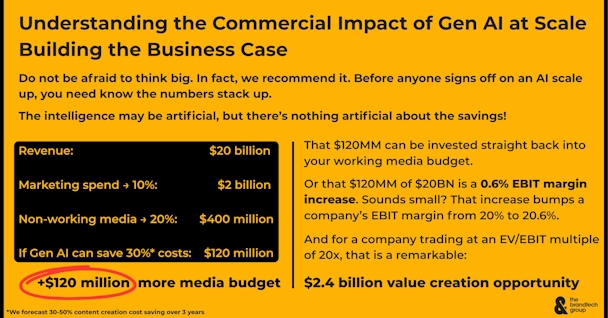
We did some maths on this, which can be applied to any sizeable brand. And when you’re thinking big enough, then the impact, the savings, the potential to reinvest in working media budget, are transformative.
There is not one client I’m talking to who is not spending most of their time in a state of overwhelm. Even if it’s not the complexity and the shifts that need to take place, it’s the velocity and volume of action that need to be managed and delivered.
One of our clients refers to this as absorbability – the ability of the team to absorb new information. If that is at -10 across your team, your AI transformation process is going to fail, or at least stall, because people can’t learn or process any more information at this point. If you’re attempting the scale of transformation outlined in points one and two, then this is critical.
Once you have freed up 10% of a team’s collective time, the ability to learn and absorb new information is much more likely to land well.
Therefore, we have been putting proactive teams into client worlds. These pods of gen AI experts help deliver against the low-hanging fruit – either the things that create the most pain and therefore are disproportionate time-sucks or the things you do in high volume that could just go away with automation and intelligence.
It’s been my personal motto – maybe I’m a masochist – and now my team’s focus, too, to lean into what is hard about the transformation process and the subjects that feel thorniest with AI.
First, it was the legal landscape. Next was ethical and responsible AI – we know what we can make, but what should we make? And now, increasingly, it’s about the environmental footprint of AI.
We decided to take the first steps in developing a methodology to allow you to calculate the environmental impact of using AI for specific marketing use cases – and built out technical mitigations to help you reduce that in our tools. We didn’t just want to highlight the problem; we wanted to start to find solutions.
Similarly, there are, rightly, ethical questions around areas such as synthetic humans and the bias found in the training data of AI models. Alignment of your DEI commitments and brand values with your plan to scale AI should be front and center – not an afterthought.
We all know that bias is inherent in AI’s training data. But if you think there’s nothing to be done here, I disagree.
When we found some AI models were generating 100% images of men when promoted simply for ‘a CEO,’ we decided to lean in and see what technical mitigation we could build on top. And our Bias Breaker tool was born, improving prompts with more nuanced versions to help brands generate assets that are more inclusive and intersectional – and better reflect society.

Two examples of being able to inch closer to a better situation if you lean into the challenges – as well as the opportunities – that AI puts in your path.
AI is in everything; it’s everywhere. The value to be gained within marketing teams and across advertising is clear to see, with many of the world’s top 10 largest advertisers well on their way to rolling out gen AI at scale.
Don’t think small, don’t shy away from the hard stuff, don’t ignore tech overwhelm and fatigue – and, perhaps most importantly, be clear in your direction, be decisive, and act with conviction.

