


Kantar’s Vera Sidlova tested 350+ gen AI ads to show the tech is no magic wand for effectiveness, even if emotional responses are in overdrive.

A wild still from a viral GenAI ad for Kalshi
Last week, Andrew Tindall tested 18 AI-generated long-form ads from the US, UK, and Australia, and posited that gen AI ads are more effective than traditionally produced content. He argued that marketers can take that as a green light to use GenAI tools.
We put his hypothesis to the test by analyzing more than 350 ads created with gen AI, and the results were a mixed bag. The broad landscape of gen AI ads isn’t as rosy as it appeared. We know that humans can create both good and bad ads. Turns out, so can AI.
Advertisement
This wasn’t cherry-picking. We analysed all the ads in our database that had either obvious gen AI elements (that an average person would notice) or where it was used in a way that a casual viewer wouldn’t be able to tell. This gave us a picture of reactions to the full range of gen AI ads out there. Not just the highest calibre, industry-lauded examples.
AI is neither a creativity killer, nor a saviour
The big takeaway of our study was that there is currently little correlation between the use of gen AI and effectiveness.
On average, gen AI ads score slightly lower on branded cut-through and enjoyment, and this is particularly the case when the AI is obvious to viewers. So, advertisers aren’t necessarily paying an “effectiveness tax” if they do use the tech, but there’s no inherent upside either.
Ads where gen AI was used more seamlessly performed better, with over 40% landing in the top tier for branded cut-through. This shows us that advertisers who learn how to use these tools well can absolutely turn them to their advantage and create high-quality, effective work.
In contrast, ads with distracting or unnatural visuals - typically those with more obvious gen AI involvement - performed worse. So, AI can help create standout successes, but can also lead to notable misses. It’s not about whether you use gen AI, but how you use it.

AI ads are emotionally engaging, but not always in a good way
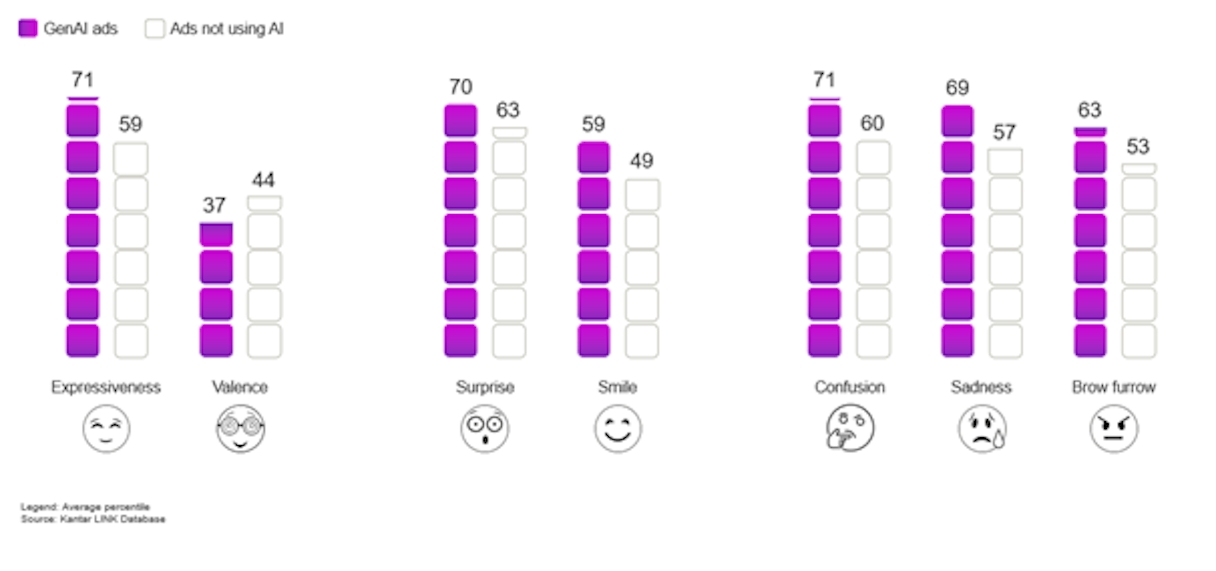
The research also captured what people feel (rather than what they say they feel) about gen AI ads by using facial coding. This measures viewers’ emotions and attention by using AI to analyse the minutiae of their facial expressions. We found that people have strong emotional responses to gen AI ads – both positive and negative. But overall, the responses skew more towards negative reactions, like confusion or sadness.
That’s a big watch-out.
We want the correct responses to our ads after all.
Advertisement
To understand why this was happening, we dug deeper into the individual cases. We found that this tends to occur when the generative visuals are distracting or intrusive in some way, becoming either off-putting or detracting from the ad’s narrative.
So, those marketers using AI need to make sure they are evoking the right emotional reactions. Sometimes people reacted with both discomfort and smiles at uncanny visuals, for example. But if people are laughing, you need to know that they’re laughing with you, not at you.
Branding amid the blanding
Being well-branded is the backbone of effective advertising and comes from meticulously using distinctive brand assets and putting the brand at the heart of the core idea. But AI isn’t your brand manager. You need to get AI models to do their homework on your brand before they can deliver high-quality work for you.
Advertisement
Our study found thatAI ads where the gen AI use was obvious scored poorly on branding, compared with those where it was less obvious. This is because the models used weren’t tailored to the brand’s tone of voice or its distinctive brand assets.

To make sure your brand is front and centre, you need to integrate your brand elements into the creative process and train any AI tools used. An example of this comes from the UK agency Faith (VCCP) and O2. The brand’s mascot, Bubble, was previously reserved for big campaigns because of resource constraints. With a specifically trained AI model, it can now generate bespoke visuals of Bubble for consistent assets across touchpoints.
There’s always demand for easy answers. A green light or a stop sign. But when it comes to creative effectiveness, the laws of physics apply whatever tool has been used to create the content. It has to stand out, it has to resonate with people, and it has to be well-branded. gen AI can help you do that, but using gen AI is not, in itself, a guarantee.