
The beginning of a new year is always a great time for predictions and resolutions, so let me add mine.

I predict this will be the last decade of growth for paid search advertising as a category.
Now, you may look at these figures and call me crazy.
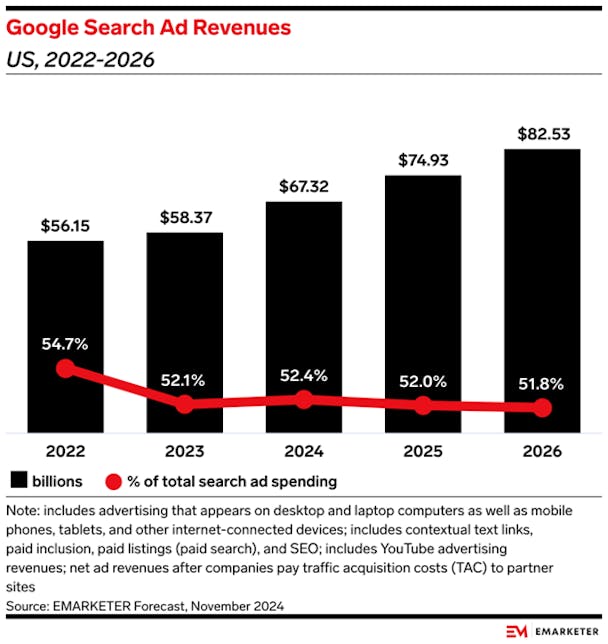
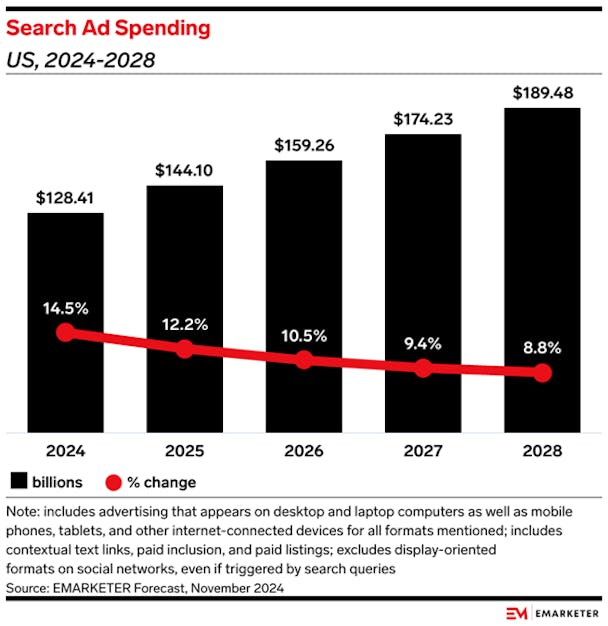
EMARKETER is projecting more than $7bn in growth each of the next two years for Google search ad revenue and $15bn per year for each of the next four for the overall category.
Here’s how I see it…
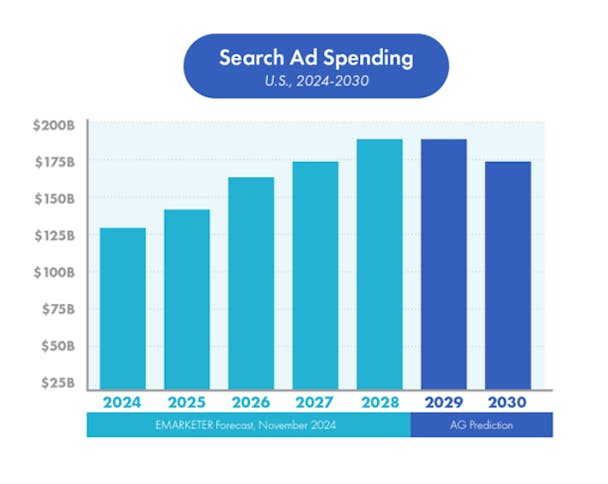
So, what would cause these bars to suddenly start shrinking? And where will all that money go?
Let’s start with a quick walk down memory lane. In my last article, I noted – ok, boasted – about how the book I wrote in 2010, Everything I Know About Marketing I Learned From Google, proved prescient and what I called ’app-sisstants‘ at the time turned out to be what we now call AI agents, such as ChatGPT and Gemini.
From roughly 2000 to 2020*, paid search was the most effective ad format on the planet – at least as far as last-click attribution models were concerned. And today it’s still the largest in terms of total spend.
Marketing professor Jim Lecinski coined the term Zero Moment of Truth (ZMOT), referring to the impact of reaching consumers at the precise moment after they’ve indicated what they were looking for online and before they’ve decided where to get it. And you can be sure ZMOT rhymed with profit.
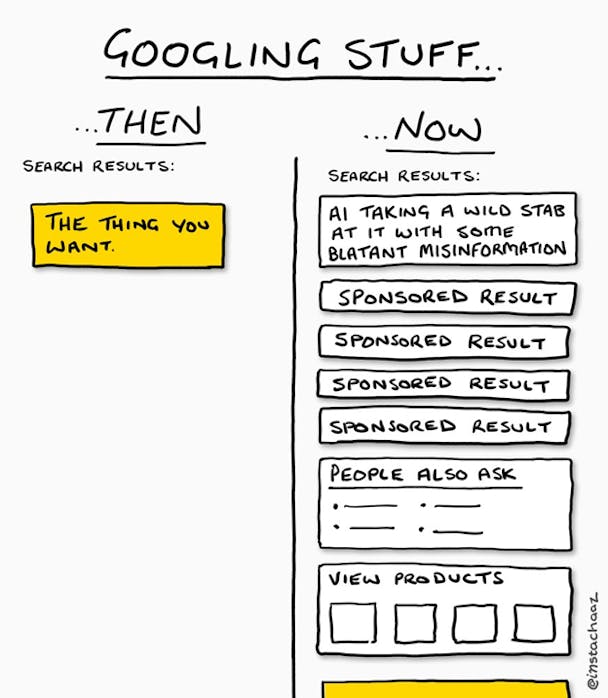
This graphic posted by Chaz Hutton on Bluesky captures the essence of the paid search monetization machine.
Working with my colleague Kristin Sanford, I clapped back on Bluesky with this graphic riffing on how ChatGPT is poised to incorporate advertising.
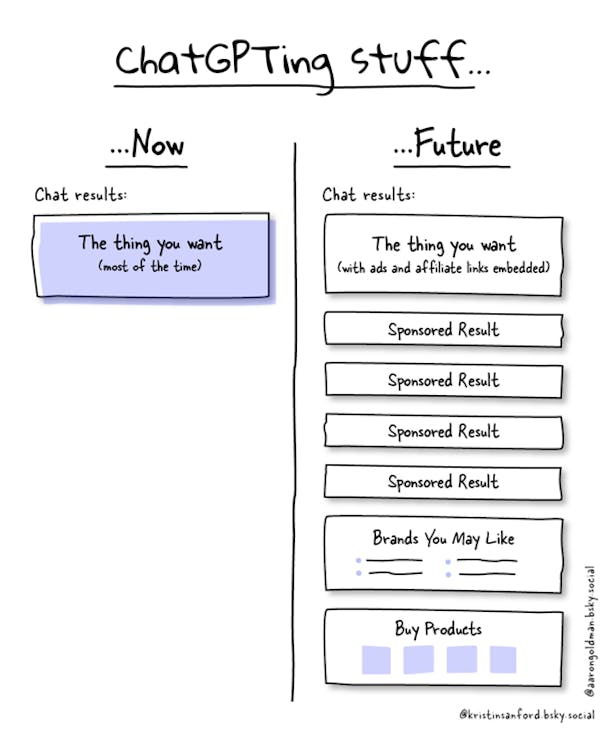
And this, in a nutshell, is my thesis for why paid search will stop growing.
With OpenAI exploring advertising and Perplexity already experimenting with it, it’s only a matter of time before agentic AI becomes the fastest growing – and most profitable – ad format in the history of the universe, stealing share from several sources, but primarily paid search.
There are, of course, other factors in play that could lead to a decline in search advertising. With Google devoting more real estate to AI on the search engine results page (SERP), there’s simply less space for paid search listings.
Another hairy meatball is the US DOJ antitrust prosecution and potential spinoff of Chrome and other Google assets, including pieces of its ad tech stack. As I told Adweek, any remedy that requires divestiture would negatively impact Google search and, in turn, search ad spend.
There’s also the specter of Google’s deal with Apple as the default search engine unraveling. If Apple had to find a replacement, it would surely not monetize as strongly, leading to less ad revenue for the paid search category.
To be sure, a migration of ad spend from paid search to agentic AI isn’t all bad for Google, as Gemini is one of the top ’app-sisstants‘ on the market. And Apple can stop worrying about building its only search engine or paid search offering and just skip straight to Apple Intelligence ads.
To me, it’s not a question of if this migration will happen but when it will.
When I first drafted this piece, the working title was: ”My 2025 prediction: this will be the last year of paid search growth.“ I really wanted to focus on just 2025 and proclaim it the ”Year of Agentic AI“ but then I remembered how many years we proclaimed the ”Year of Mobile,“ so I decided to sandbag.
Even putting a four-year cap on growth for paid search seems risqué given the current trajectory tracked by EMARKETER and the like.
In my mind, the biggest barrier to billions of ad spend moving from paid search to agentic AI will be the advertisers themselves.
I fondly recall the annual Mary Meeker chart showing that ad spend lags time spent. Here’s the one from 2014.
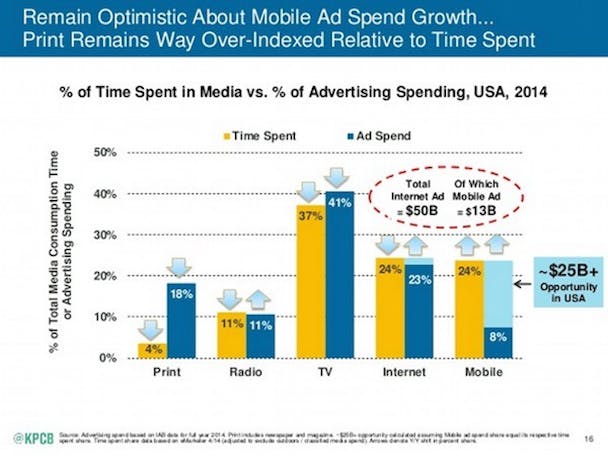
Nowadays, it’s not time spent that moves the needle on advertising – it’s money spent. As consumers turn to AI agents like ChatGPT to handle the navigational and transactional tasks that used to be relegated to search engines, the ad spend gap will close more quickly than you can say: ”Hey Google.“
Once again, I turned to Kristin for a quick render on how things will play out.
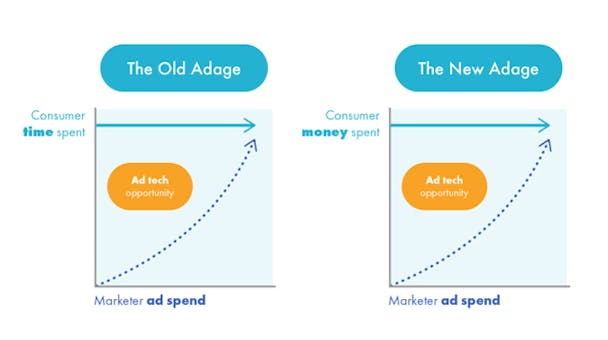
Search advertising was actually the first format to buck the old trend. People don’t spend a lot of time on search engines. In fact, if the search engine is doing its job well, consumers spend very little time there.
*Remember this asterisk up above? What happened around 2020 that stopped paid search from being the most effective ad format – at least as far as directly attributable ROI was concerned? Oh, just a little thing called "retail media" which inserted ads even closer to the point of purchase (aka ZMOT) than Google was ever able to.
Retail media is another example of the new adage in play. By displaying ads directly on the pages where people are spending money – and using that first-party data for offsite targeting – marketer ad spend for the category has grown dramatically despite very little time being spent in these environments.
FWIW, I expect retail media to continue to grow into the next decade before eventually succumbing to agentic AI ads as well, likely in some form of cost per acquisition (CPA) affiliate marketing embedded into the ’app-sisstant‘ experience.
For now, though, search ad spend will take the brunt of share erosion due to the rise of agentic AI ads.
So, there you have my predictions. Now for the resolutions.
See the yellow bubble in my adage chart above? That represents ad tech opportunity.
The imperative for everyone who works in advertising is to explore ways to leverage technology to close the gap between money spent and ad spend.
This means tools for workflow, optimization, measurement, etc. Ad tech is primed to help marketers manage feeds that insert brand assets into the walled gardens of AI agents.
Just like we saw in search advertising and retail media, an entire Lumascape of companies will crop up for agentic AI ads.
And the best practices from those categories – as well as the Googley Lessons in my book, which I rehashed in my last article – will still apply.
Ready or not (but preferably the former), the year of agentic AI ads is coming.
At the end of the day, you don’t have to be first, and you don’t have to be best, but you do have to be better.
By my calculations, you’ve got ’til the end of this decade to figure it out!

