

Modern marketing’s obsession with short-term metrics overlooks its real value, writes Andrew Lipsman.

Photo by Diana Polekhina on Unsplash
As I waited in the wings to present at SMG’s UK Retail Media Summit in October, Rory Sutherland regaled the audience with a masterful keynote on the behavioral economics of retail media. The human aspects of retail and advertising, he argued, are getting lost in a modern business culture obsessed with measuring and optimizing everything for short-term outcomes.
“A large amount of what is now called performance marketing is really a business of gaming metrics rather than the proper business of marketing,” he said. “You’ve probably heard the phrase ‘what gets measured gets managed,’ and you probably heard it attributed to Peter Drucker, who never said it, and you probably heard it said by someone in finance really approvingly. The origins of the phrase – first of all Peter Drucker never said it, second it was intended as a criticism. This was a criticism of what’s known as quantification bias, which is you think important what you have to be able to measure rather than measuring what’s really important.”
It was a funny way to kick off a conference on retail media, which has always been viewed as the ultimate performance channel. Retail media’s fundamental promise: closed-loop targeting and attribution linking digital ads to product sales.
In fact, this very mechanism fueled my early thesis, back in 2018, that retail media would become the next major evolution in digital advertising.
In 2021, I translated this idea into a visual depicting retail media as “The Third Big Wave of Digital Advertising,” following in the footsteps of search and social media. The graphic even ran in the Financial Times.
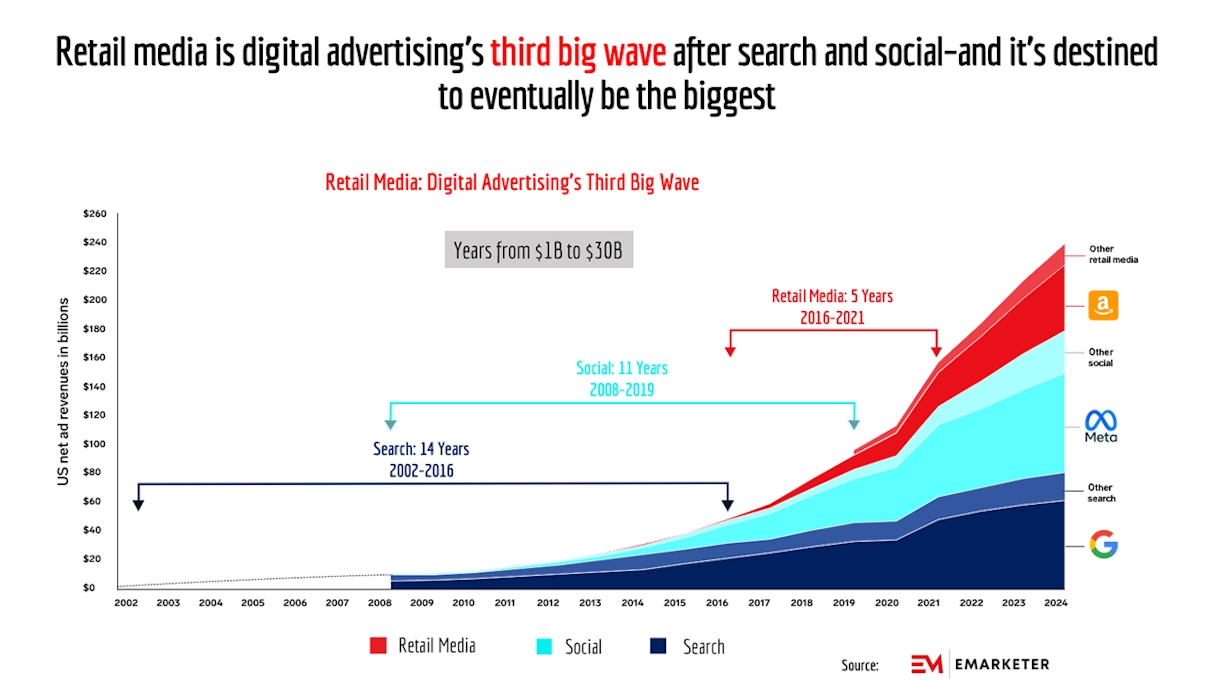
To many observers, this was perhaps a defining moment that set off the retail media hype cycle, casting me as the trend’s resident hype man. But much like the fake Drucker quote, embedded within my rather optimistic-looking chart was a deep critique of the current state of digital advertising.
Advertisement
Even though I believed in the underlying substance of retail media, “The Third Big Wave” simply reflected the anticipated flow of digital ad dollars—which I understood would be dictated to an egregious degree by quantification bias.
The first big wave of digital ad dollars was unlocked by Google’s original advertising vending machine. Put $1, get $2 out, keep spending until the return on ad spend (ROAS) no longer pencils. Advertising investment had never been so easily and elegantly quantifiable (or so it seemed), and the dollars poured in.
The second big wave gathered momentum when Facebook retooled its platform to emphasize performance advertising over reach and impressions. And Facebook got better and better at putting ads in front of the audiences most likely to convert – and taking credit for those conversions whether their ads caused them or not.
The exact same force has propelled the third big wave from less than $10bn in US ad spend in 2018 to $60bn in 2025.
Today, these three ad markets collectively account for more than $250bn. But the majority of these dollars are invested as byproducts of quantification bias, with little to no regard for marketing effectiveness. (In fact, the US market has become so enamored with digital technology and the quantitative aspects of advertising that, as Mark Ritson has argued, marketing effectiveness has almost vanished as a discipline.)
For all three ad markets, ROAS is the primary culprit. It is easy to measure, so it is the metric that gets managed. Unfortunately, ROAS is a very costly misnomer, because it doesn’t measure what it purports to measure. It functions as a proxy metric for incremental sales (or iROAS) – the true underlying objective of most businesses – even though the two things aren’t correlated.
By now, you may be wondering if retail media’s hype man is actually a critic. And the answer is both yes and no. How retail media advertising is often practiced today leaves a lot to be desired. Tens of billions in retail media ad spend chase branded search and retargeting ads that do wonders for ROAS but little to produce incremental sales.
Nevertheless, my conviction in retail media’s inherent value is as strong as ever. Because the marketing effectiveness argument is too compelling to ignore. Stripped down to its essence, retail media is about targeting ads to audiences using best-in-class data in commerce-adjacent contexts. Whether or not it’s effective still depends on sound marketing strategy and high-quality creative, but the conditions are otherwise conducive to marketing effectiveness.
And these fundamentals apply just as well to long-term brand-building as they do to short-term sales performance. This underrated element of retail media will get harder to overlook as it fuels media innovations like performance TV and in-store digital in the coming years.
As it turns out, Sutherland also isn’t a retail media cynic. Rather, he believes it’s just misunderstood. Using the alchemy for which he is famous, Sutherland closed his keynote with an elegant reframing of retail media as “context-sensitive brand-building.”
“One of the things I like about retail advertising is it’s a new form of advertising – which can be as digital as you like and as targeted as you like – but at least it’s sensitive and relevant to the moment at which it’s consumed,” he said. “I’m walking into a shop, I’m entering a website, this is an entirely appropriate moment to display a [brand] logo. We can never put a quantity on that contextual relevance, so we treat it as if it’s unimportant. But I always thought it was hugely important.”
Advertisement
Every consumer decision is made within a certain context, which is often the single most important variable driving the decision. But because we don’t have a way to properly value that context with a singular metric to guide budget allocations, it is routinely ignored as part of the marketing equation.
Retail media, at its best, excels at the intersection of context and creative. When high-quality creative reaches audiences in commercial environments, marketing effectiveness is maximized.
That’s why the “digital endcap” – dynamic creative adorning the digital or physical aisle – is perhaps the most valuable advertising real estate that exists today. Where better to influence a consumer’s preference than when she’s in a shopping context with demonstrated category intent?
Indeed, the research shows that these placements are highly effective at driving incremental sales effectiveness. It’s a rather intuitive finding that shouldn’t be a surprise to marketers.
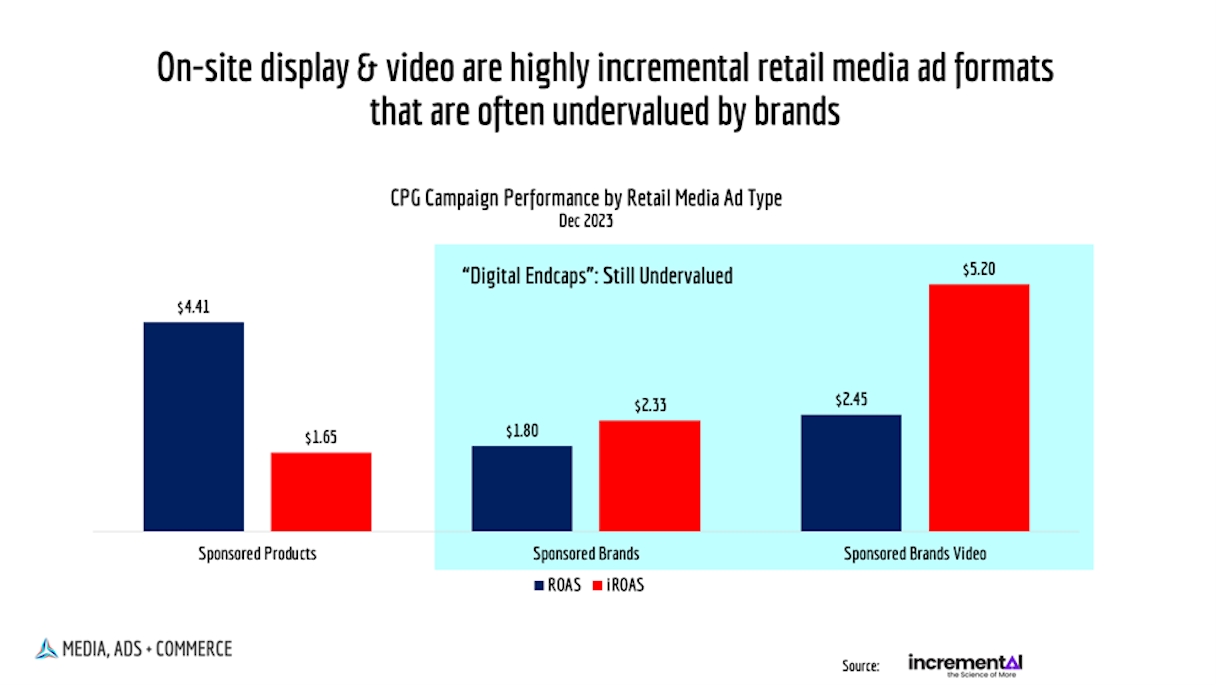
And yet, the digital endcap remains underinvested in both channels. Their higher-than-average costs scare off investment that would rather chase short-term ROAS.
Advertisement
The only problem is that high ROAS is high when prices are low, and vice versa. Since the metric merely captures attributed sales that merely occur post-exposure, it is easily gamed by running lower-cost media that happens to get attribution credit.
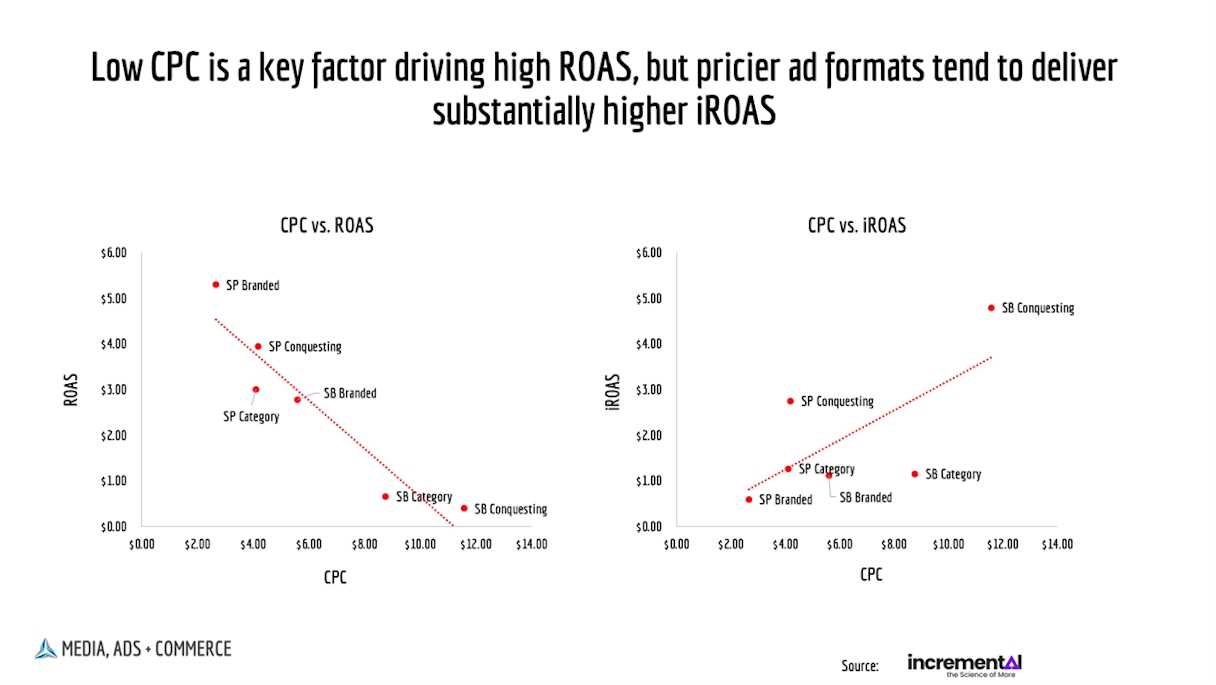
My view: premium media carries premium prices for a reason. Premium media builds brands, and brand-building drives long-term sales. And retail media is premium media.
But apparently that’s a conversation best left for the marketing effectiveness folks, a dying breed. Because who cares about creative, context, and strategy – all those squishy things that can’t be measured?
Marketing is now for the managers. You just need to give them something – anything, really – to measure.
Andrew Lipsman is a US-based independent analyst and consultant. He writes the Media, Ads + Commerce newsletter on Substack and will contribute to The Drum’s enhanced coverage of retail and commerce media throughout 2026.
Commerce media is moving fast. The Drum Awards for Commerce Media are here to recognise the work keeping pace - and setting the standard. Join us in Miami in April as part of The Drum’s year-round Commerce Media program. Learn more and enter.