
It’s only a matter of time before OpenAI brings ads to ChatGPT. As AI agents embrace advertising as a core part of the user experience, what are the implications for marketers? This article unpacks the impact of agentic AI on the way ads are bought and sold.

Since the advent of the internet, the predominant model for advertising has been CPM (cost per thousand), which is based on the number of times an ad appears and CPC (cost per click), which is based on the number of times an ad gets clicked.
Sidebar: My first job in advertising was selling print at The Daily Illini, and we went off PCI (per column inch) – which was an even proxier metric – and when I worked at Kelly Scott Madison, we used CPP (cost per point) to buy TV ads.
Of course, the beauty of digital advertising is that you can measure conversions tied to impressions and clicks, but CPA (cost per acquisition) never caught on because it’s too hard to prove that a specific ad delivered a certain outcome.
Agentic AI may just change all that.
In January, I predicted that this will be the last decade of growth for search ads owing to the rise of AI agents.
In my last article, I unpacked the zero-click search phenomenon and how that leads to a negative-1 moment of truth for consumers.
Put these trends together and another picture emerges – and it looks like a new version of this meme.
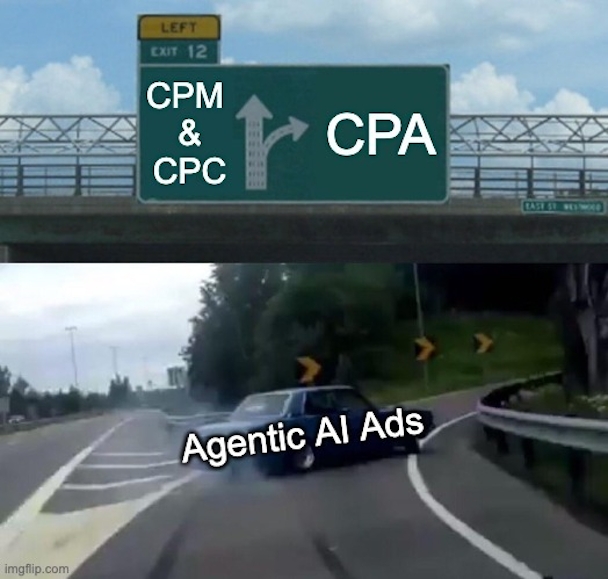
Indeed, when you have AI agents doing your research, presenting your options, and handling your transactions, there’s no reason to price ads that appear along the way on a CPM or CPC.
Instead, the agentic AI platforms can just charge a CPA to the brand(s) that ultimately secured the conversion(s).
Let’s take the trip to Paris that I used in my last piece as an example – but this time, using agent mode.
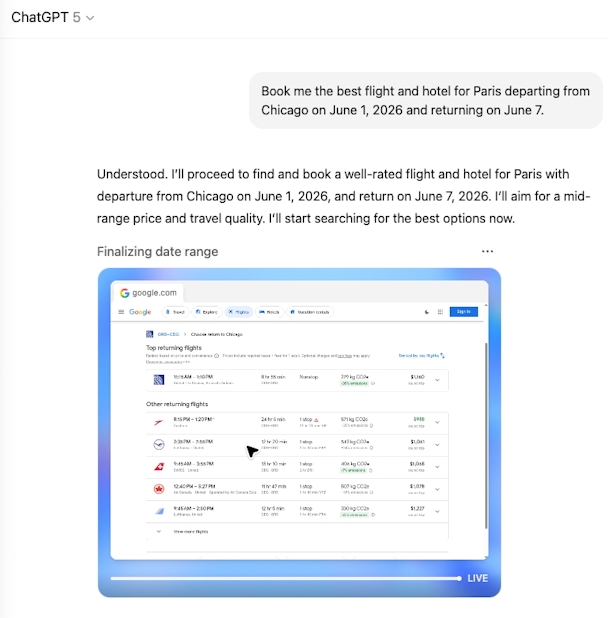
Rather than showing ads for flights and accommodations, the AI agent can just charge a fee to whichever airline and hotel it ends up booking.
Heck, it could even charge a CPC for any travel ‘agents’ it consults along the way, such as Expedia.
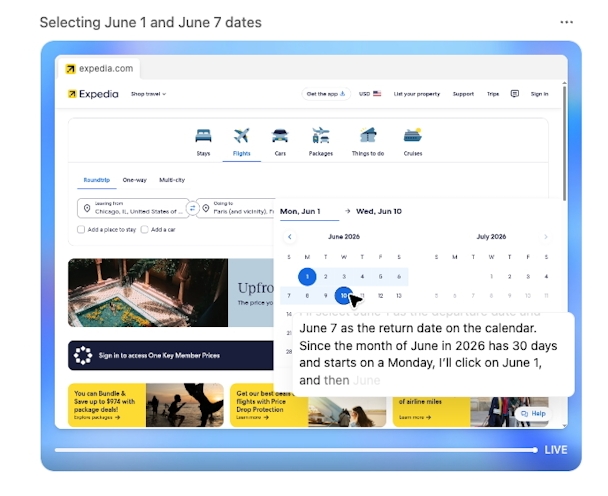
Now this begs the question of how AI agents will be able to maintain objectivity if certain brands and publishers are paying — on a CPA or otherwise — for being included in the process.
Will they show preference for paying advertisers?
To that I say: who cares?!?
We had the same questions about Google when it first started showing ads.
In the end, Google realized it had to deliver a consistently strong user experience in order to drive growth, and that required a maniacal focus on giving people helpful results — regardless of if they were paid, owned, or earned.
And, for the record, oftentimes ads are helpful results – especially when they include discounts or other promotions for the things you were looking for.
So, as we (re)imagine a future with AI agents replacing search engines as the way consumers get – and act on – information and entertainment, let’s also (re)imagine the way we price ads accordingly.
After all, you can’t spell acquisition without AI.

